The importance of market direction


Most traders know this: as a trend follower you need a trend. Without it, setups may appear but they fail all the time. Best to sit on your hands. But how seriously do we actually need to take this? Where does this come from?
Let's dig a little deeper into this subject.
Traders used to talk about the importance of the market trend way back.
Jesse Livermore talks about a man named Mr. Partridge who keeps saying to his customers they are in a bull market in chapter 5 - Reminiscences of a Stock Operator.
I think it was a long step forward in my trading education when I realized at last that when old Mr. Partridge kept on telling the other customers, "Well, you know this is a bull market!" he really meant to tell them that the big money was not in the individual fluctuations but in the main movements that is, not in reading the tape but in sizing up the entire market and its trend. - Jesse Livermore
William O'Neil writes about it in his book "How to make money in Stocks". He did decades of research with his company William O'Neil & Co. They analyzed the best performing stocks since the late 19th century and concluded that regardless of how fundamentally strong a company is, 3 out of 4 stocks simply yield to the general market trend.
You can be right on every one of the factors in the last six chapters, but if you're wrong about the direction of the general market, and that direction is down, three out of four of your stocks will plummet along with the market averages, and you will lose money big time, as many people did in 2000 and again in 2008. - William O'Neil
IBD still stands behind this claim: IBD - investors.com talks about how 3 out of 4 stocks follow the general trend.
3 out of 4 follow the general market trend, so trading in sync with the market is key to your investing success. https://www.investors.com/how-to-invest/investors-corner/stock-market-trend/
Some interesting research
Benjamin F. King in 1966 examined price movement of stocks. He concluded that the whole market movement explains about half the variance (volatility) of an individual stock. The sector in which the company operates adds another 10% to 15% to that. Combined, this shows that roughly two-thirds of a stock's price movement depends on the broader market and the sector, and not on the company itself. - https://www.semanticscholar.org/paper/Market-and-Industry-Factors-in-Stock-Price-Behavior-King/a1b20a1d3dd6b65cf95196c83790f3826bf0624d
William Sharpe's Modern Portfolio Theory & CAPM from 1964 is another interesting one. According to the Capital Asset Pricing Model (CAPM), a stock's total risk is split into two distinct components: unsystematic risk (company-specific factors, such as a poor CEO decision or a bad product) and systematic risk (market-wide factors, including interest rate shifts, inflation, overall market sentiment). Financial theory proves that while you can diversify away company-specific risks by holding a portfolio of assets, systematic risk is unavoidable, it impacts virtually every single stock. - https://www.jstor.org/stable/2977928
A recent example
Sandisk Corporation SNDK
This thing launched into space for around 200% over the last few months. If we look closer on the 29th of January 2026 earnings became available for that quarter. And the numbers were huge.

But it only really started flying on the follow-through-day (FTD) on April 8th 2026, when the recent lockout rally started. It even had a failed breakout in the base after the earnings call.
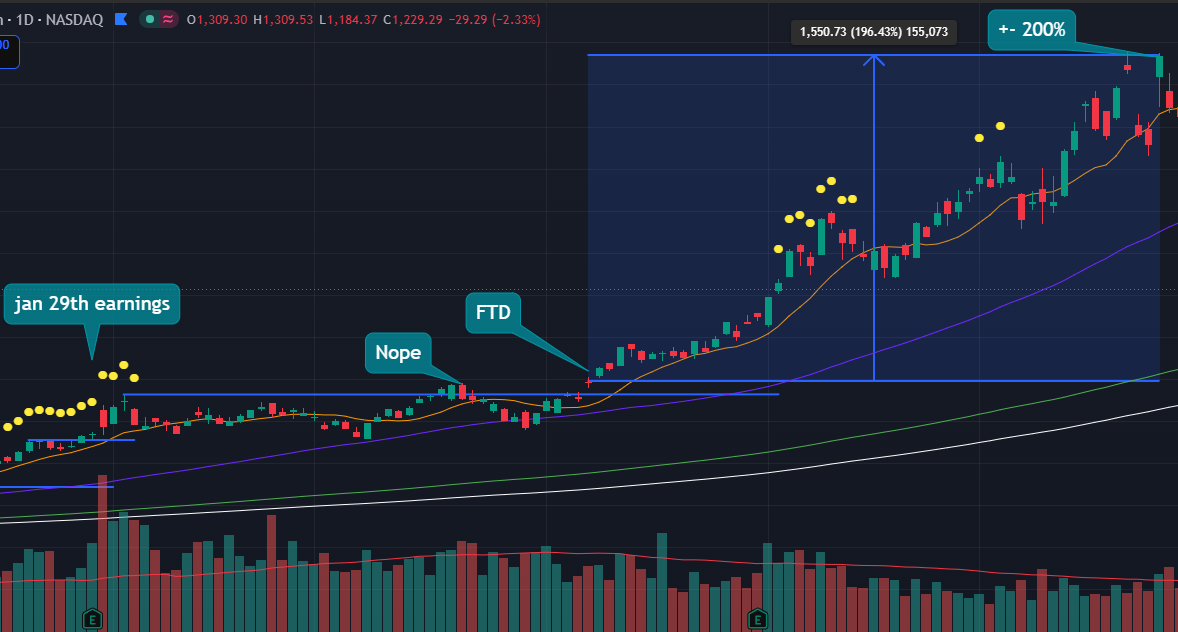
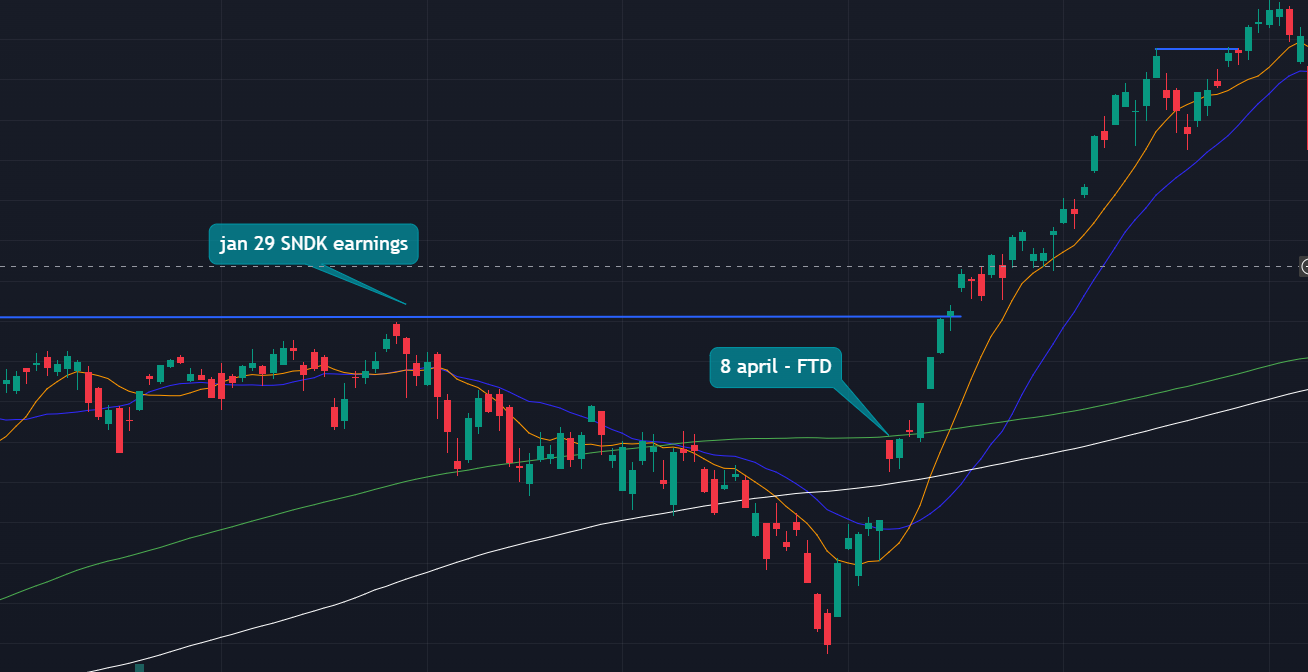
As you can see on the Nasdaq Composite Index (IXIC), the market noped-out and went down. SNDK held up its pants very nicely but it did not start going yet. Once the market started going, so did SNDK.
Ultimately, whether you look at century-old wisdom from Jesse Livermore, decades of data from William O'Neil, academic research, or a modern chart like SNDK, the message remains exactly the same: the market is the tide, and your stock is just a boat. You can have the best fundamentals and earnings in the world, but if the tide is going out, your stock is going down with it, or at best, grinding sideways and showing relative strength until the market pressure lifts.
So the next time the market starts breaking down, remember O'Neil's 3-4 rule and respect the risk. Sit on your hands, protect your capital, and wait for the broader market to give you the green light before you start buying again. Patience pays.
Disclaimer: The content of this blog is for educational and informational purposes only and does not constitute financial advice. The author is not a certified financial advisor. All analysis is based on historical market data and technical methodologies. Trading stocks and cryptocurrencies involves significant risk. Always do your own due diligence and consult with a professional financial advisor before making investment decisions.


